Framing Islam in the Attention Economy: Algorithmic Mediation and Digital Soft Power in the 2022 Qatar World Cup
Sara Hassan
Department of Journalism & Mass Communication, American University in Cairo, Cairo, Egypt
Abstract
This study explores how YouTube algorithms and media economics shape global public perceptions of Islam during the 2022 FIFA World Cup in Qatar. As a Muslim-majority host nation, Qatar sought to project a moderate Islamic image while facing Islamophobic and orientalist framings from Western media. Using a mixed-methods approach that combines text mining, content analysis, and topic modeling (LDA), the study analyzes both YouTube videos and user comments, alongside international and Indonesian news coverage. Results indicate a sharp contrast between negative media portrayals and supportive public responses, with YouTube comments often resisting mainstream narratives. These findings challenge the spiral of silence theory and affirm reception theory, highlighting audiences’ active role in negotiating meaning. Moreover, the study emphasizes the role of algorithmic visibility and attention economy in amplifying or suppressing religious narratives. The research contributes to digital religion, media studies, and strategic communication by demonstrating how digital platforms become contested arenas for cultural diplomacy and public meaning-making.
Keywords
Introduction
In the digital era, social media and video-sharing platforms have emerged as new public spaces where issues of religion, culture, and global politics are openly debated (Edgerly et al. 2009). The development of communication technologies has not only transformed communication patterns but also reshaped how global societies form perceptions and opinions, including their understanding of Islam (Abokhodair et al. 2020). Digital media facilitates cross-border and intercultural interactions, enabling individuals from diverse backgrounds to express opinions, respond to global issues, and both produce and consume religious narratives in more fluid, real-time, and diverse formats. Digital media also contributes to the expansion of religious practices and serves as a new space for the construction of religious meaning, but on the other hand, it is also used to spread disinformation, intolerance, or religious stereotypes (Campbell 2017; Bunt 2009).
YouTube is one of the platforms that plays a central role in constructing global public opinion. As a video-based social media platform with a powerful recommendation algorithm, YouTube not only enables the widespread distribution of visual content but also creates space for discussion, comments, and public participation in responding to sensitive issues such as religion, human rights, and culture (Burgess and Green 2018; van Dijck 2013). In this context, YouTube becomes a strategic platform that can influence public perceptions of Islam, either positively or negatively (Susarla et al. 2012). This phenomenon becomes highly relevant when examining the 2022 FIFA World Cup in Qatar, a Muslim-majority country placed under global media scrutiny. This international sports event was not merely a competition but also a symbolic arena of contestation between dominant Western media narratives and the representations of Islam that Qatar sought to project (Hussain 2021). Western media, often characterized by Islamophobic and orientalist tones, frequently portrayed Qatar negatively by highlighting issues such as human rights, the treatment of migrant workers, and attitudes toward the LGBTQ community (Ridouani 2011; Said 1979; Hussain 2021). These framings cannot be separated from the media industry's vested interests in capitalizing on sensitive issues to drive engagement, which is a key source of monetization in the digital media economy (Papacharissi 2015).
However, such dominant narratives are not always passively accepted by audiences. YouTube, as a space for dialogue and interaction, allows for the emergence of comments that reflect resistance, support, or reinterpretation of the presented content. This suggests that audiences are not passive but actively interpret, and even challenge, dominant narratives (Fiske 1987; Khotimah et al. 2024). In this study, the analysis of public YouTube comments during the 2022 World Cup aims to uncover the complex dynamics of opinion, ranging from support for the Islamic values promoted by Qatar to critiques of Western media’s biased framing. This study also seeks to further explore the relevance of the concept of affective publics, where digitally expressed public emotions help shape collective opinion (Papacharissi 2015).
To understand the dynamics of public opinion in digital spaces, this study employs two main theories: the Spiral of Silence by Elisabeth Noelle-Neumann and Reception Theory by John Fiske. The Spiral of Silence posits that individuals tend to withhold their opinions if they feel out of step with the perceived dominant view, due to social pressure to conform (Noelle-Neumann 1974). In contrast, Reception Theory emphasizes that audiences are not passive recipients of media messages; rather, they actively interpret, reject, or modify meanings based on their cultural, religious, and personal experiences (Fiske 1987). Through these perspectives, the study seeks to examine whether the Western media's framing of Qatar and Islam during the 2022 World Cup truly shaped global public opinion or whether audiences resisted these narratives through their YouTube comments.
This research aims to identify and understand how Western media framed Islam during the 2022 World Cup and how this framing was received, commented upon, and responded to by global audiences. Using text mining and topic modeling on YouTube videos and user comments, this study intends to reveal patterns of public engagement in shaping, rejecting, or modifying digital representations of Islam.
The study contributes to interdisciplinary discourse in the fields of digital religion, media studies, and media economics, especially in the context of religious narrative contestation in digital spaces. By empirically approaching the phenomenon through media analytics, this research also enriches our understanding of how social media platforms like YouTube are used not merely for information dissemination but also as arenas for competing over meaning, opinion, and religious imagery in an increasingly connected global order (Mila Rosa et al. 2022). The digital religion approach is crucial in examining how Qatar strategically employed digital media as a tool of soft power (Youssof Mohamed Salhein 2018). In this regard, digital media becomes a battleground between the commodification of Islamic narratives by Western media and Qatar's cultural diplomacy strategies, both operating within the frameworks of the attention economy and algorithmic logic. By analyzing the interplay among content, algorithms, and audience participation, this study positions YouTube as a critical arena in the formation of global public opinion about Islam.
Framing Islam in the Attention Economy: Algorithmic Mediation and Digital Soft Power in the 2022 Qatar World Cup
Method
This study employs a media analytics approach based on text mining to analyze digital narratives surrounding the 2022 FIFA World Cup in Qatar, particularly those disseminated through YouTube videos and online news media from both Western and Indonesian sources. This approach enables researchers to explore the structure of discourse while also understanding how issues such as negative sentiment toward Islam, human rights, and religious values are constructed, distributed, and consumed within a digital media ecosystem governed by algorithms and commercial logic. The primary method used in this study is Latent Dirichlet Allocation (LDA), a topic modeling algorithm designed to extract dominant topics from large text corpora (Blei et al. 2003). This algorithm identifies hidden thematic structures across thousands of YouTube comments, video transcripts, and news articles, thereby providing insights into how digital narratives are formed and consumed by the public. To enrich contextual understanding, text summarization techniques were also applied to condense long-form articles into thematic summaries, alongside content analysis of the resulting topics. The text summarization process was conducted using Python programming libraries and scripts. As shown in Figure 1, the dataset collection process involved several methods. YouTube data were gathered using Python-based scripts to convert video or audio content from YouTube into text format. For the online news dataset, relevant articles were retrieved through Google search or similar tools, and their content was extracted using Python programming.
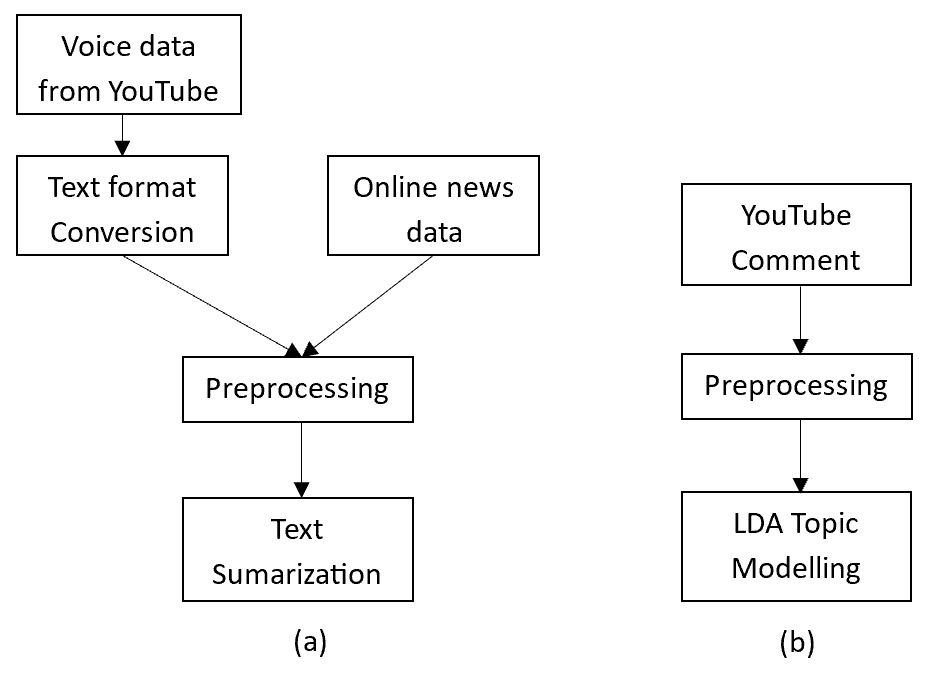
Figure 1: Sources of Research Data
The next stage after the dataset has been converted into text format is preprocessing. Preprocessing is a crucial step in preparing textual data for analysis. The input consists of documents or strings, and this stage generally involves several sub-processes such as lemmatizing, case folding, tokenizing, stop word removal, stemming, and others. Lemmatizing refers to the process of reducing words to their base or dictionary form. In this study, the preprocessing step involved stop word removal while retaining words with prefixes and suffixes. The preprocessing was performed using the Sastrawi Python library, which is widely used for stemming Indonesian-language text (Python Sastrawi, n.d.).
Once preprocessing is complete, the dataset is ready for further analysis. For transcribed content from YouTube videos and news articles, the next step is text summarization, which generates thematic summaries of long texts. For the YouTube comment dataset, topic modeling is applied using the Latent Dirichlet Allocation (LDA) algorithm. The topic modeling process identified three main topics that represent the entire comment corpus. For each topic, one comment with the highest topic probability contribution is selected to represent the overarching narrative of that topic.
This methodological approach also aims to understand how the dynamics of information production, distribution, and consumption operate within a digital media ecosystem driven by algorithmic logic. It is intended not only to explore ideological narratives but also to examine content management dynamics, audience participation patterns, and framing strategies used by the media to generate profit through the capitalization of religious and political issues. The negative narratives emerging from Western media toward Qatar during the 2022 World Cup can be understood as part of the media industry's strategy to increase audience engagement by leveraging sensational content that exploits issues related to religion, human rights, and cultural value conflicts. In this context, the framing of Islam and Qatar is not merely an expression of ideology but also a form of issue commodification aimed at generating clicks, views, comments, and advertising revenue.
Finding And Discussion
Text Mining of YouTube Transcripts and Comments
Text mining using YouTube as the source for content related to the 2022 FIFA World Cup in Qatar is divided into two parts: text mining of YouTube video transcripts and text mining of user comments on those videos. The transcript-based text mining focuses on identifying dominant narratives within the content of YouTube videos and is categorized into five major topics for each video analyzed, all of which are related to the Qatar 2022 World Cup.
The following is detailed information regarding the transcript dataset:
- This is why they REALLY hate on Qatar QA – YouTube (https://www.youtube.com/watch?v=CMuhpf_wxXQ). The video, presented in a monologue format, was published on the @onepathnetwork channel. It has a duration of 6 minutes and 38 seconds, has been viewed by 386,000 people, and has received 2,932 comments from viewers. The content of the video includes the following points:
- Qatar’s role as the host of the World Cup drew global attention due to its large budget and efforts to showcase its wealth, infrastructure, and cultural identity.
- Criticism from the West directed at Qatar includes issues such as the alcohol ban (despite similar bans in Western stadiums), the treatment of migrant workers (compared with the legacy of European colonialism that also created similar issues), and Qatar’s stance on LGBTQ rights. These criticisms are framed in the video as examples of Western superiority and hypocrisy, portraying attempts to impose Western values on other nations as potentially rooted in Islamophobia, racism, and cultural arrogance.
- Based on the topic modeling analysis of the comments on this video, three major themes were identified, as presented in Table 1.
- Table 1. Topic Modeling Results for the @onepathnetwork Channel
| Document No | Dominant Topic | Topic Perc Contrib | Keywords |
| 6 | 0 | 0.7239 | laws, cup, west, muslim, values, things, countries, western, rights, years |
| 11 | 1 | 0.7635 | lgbt, countries, years, muslim, rights, west, things, values, cup, laws |
| 28 | 2 | 0.7144 | cup, muslim, western, countries, lgbt, years, west, laws, things, values |
Based on the three topics generated through LDA (Latent Dirichlet Allocation) modeling, it can be concluded that the dominant themes found in the comments on this YouTube video are:
- Differences in values held by the West and the Muslim world in the context of global law, rights, and culture.
- LGBT issues serve as both a meeting point and a point of conflict between the liberal Western system and the normative systems of Muslim countries.
- A comparison of culture, values, and legal systems between the West and Muslim countries.
- Qatar World Cup: European "racism" and Islamophobia on display – YouTube (https://www.youtube.com/watch?v=nYvQXojL4r0). The video, presented in a monologue format, was published on the Robert Carter channel. It has a duration of 7 minutes and 17 seconds, has been viewed by 26,000 people, and has received 592 comments from viewers. The content of the video includes the following points:
- A narrative with negative sentiment, such as belittling and mocking Muslim appearance and culture, exemplified by a German football analyst referring to Qatari people wearing traditional Arab clothing as wearing a "Qatari bathrobe."
- The emergence of negative views toward Arab Muslim countries and societies, illustrated by a French magazine’s racist cartoon portraying the Qatari national team as terrorists.
- Calls for Arab and Muslim nations to become more like Europe, accompanied by blame directed at these nations for their cultural practices or Islamic legal norms.
- The use of the "One Love" armband is framed as an effort to promote Western views and propaganda to Arab Muslim societies.
Based on the topic modeling analysis of the comments on this video, three major themes were identified, as presented in Table 2.
Table 2. Topic Modeling Results for the Robert Carter Channel
| Document No | Dominant Topic | Topic Perc Contrib | Keywords |
| 419 | 0 | 0.9108 | muslims, muslim, qatar, western_media, western, racist, time, dont, europe, west |
| 249 | 1 | 0.8096 | european, west, allah, qatar, muslims, country, bro, god, khoa, 2kin |
| 317 | 2 | 0.8249 | islam, agree, cup, brother, good, muslim, countries, better, 100, bbc |
Based on the three topics generated through LDA (Latent Dirichlet Allocation) modeling, the dominant themes identified in the comments on this YouTube video are as follows:
- Criticism of racially biased reporting by Western media toward Muslims and the state of Qatar.
- Expressions of solidarity and affirmation of Muslim religious identity in response to dominant Western perspectives.
- The emergence of appreciative narratives and defenses of Islam in the context of global events, such as the World Cup in Qatar.
- REFLECTIONS ON THE QATAR WORLD CUP | Dr. Sayed Ammar Nakshawani – YouTube (https://www.youtube.com/watch?v=1wInIi7wWmg). The video, presented in a monologue format, was published on the Sayed Ammar Nakshawani Official channel. It has a duration of 43 minutes, has been viewed by 12,000 people, and received 54 comments from viewers. The content of the video includes the following key points:
- The 1990 Italy World Cup introduced people to and helped them fall in love with Italian culture. Similarly, the Qatar 2022 World Cup is expected to offer a positive experience and a deeper understanding of Qatari culture and society.
- The issue of human rights violations in Qatar, particularly related to differing views on LGBT rights, where Western cultures tend to be more supportive, while views in the Middle East are often more traditional and conservative.
- There is a difference in views on religion, where the Middle East is strongly rooted in religious aspects due to the dominance of Islam, making religion a central part of daily life (a God-centric worldview), while Western countries are portrayed as more materialistic, secular, and where religion does not play as significant a role as it does in the Middle East.
Based on the topic modeling analysis of the comments on this video, three major themes were identified, as shown in Table 3.
Table 3. Topic Modeling Results for the Sayed Ammar Nakshawani Official Channel
| Document No | Dominant Topic | Topic Perc Contrib | Keywords |
| 42 | 0 | 0,986 | bless, may, allah, qatar, sayed, western, much, sayyed, great, keep |
| 6 | 1 | 0,975 | sayed, us, thank, lecture, one, ammar, well, amazing, world, however |
| 38 | 2 | 0,992 | great, loved, ones, people, living, sayed, also, islam, individual, care |
Based on the three topics generated through LDA (Latent Dirichlet Allocation) modeling, the dominant themes identified in the comments on this YouTube video are as follows:
- Prayers and support for Sayed, along with praise in the context of Qatar and the Western world.
- Appreciation for Sayed Ammar’s lectures and their impact on a global audience.
- Messages about human and spiritual values in Islam, as well as recognition of individual dignity.
- Qatar World Cup: Last Week Tonight with John Oliver (HBO) – YouTube
- (https://www.youtube.com/watch?v=UMqLDhl8PXw). The in-depth news segment from the LastWeekTonight-HBO channel, with a duration of 24 minutes and 47 seconds, has garnered 9.1 million views and attracted 17,954 user comments. The video covers the following points:
- Allegations that Qatar’s selection as the host of the FIFA World Cup involved bribery and corruption, alongside concerns about the extreme heat and insufficient infrastructure.
- Criticism of the kafala system, which restricts migrant workers’ rights and subjects them to harsh living conditions. This includes dependence on their employers, restrictions on travel and communication, and lack of autonomy over personal decisions. Workers are unable to leave the country or return home without employer permission, face recruitment fee deductions, and suffer from limited labor rights, including long working hours, low wages, unsafe work environments, and lack of access to adequate healthcare and education.
- Human rights violations in Qatar include discrimination against women and the LGBTQ+ community.
- The topic modeling analysis conducted on the comments of this video identified three major topics, as presented in Table 4.
| Document No | Dominant Topic | Topic Perc Contrib | Keywords |
| 212 | 0 | 0.9012 | qatar, human_rights, best_cup, soccer, middle_east, cup, love, countries, john, best |
| 704 | 1 | 0.8761 | human_rights, qatar, fifa, rights, cup, human, country, john_oliver, countries |
| 1097 | 2 | 0.8499 | john_oliver, cup, lol, qatar, fifa, john, middle_east, shit, time, modern_day |
- Table 4. Topic Modeling Results from the LastWeekTonight-HBO Channel
- Based on the three topics generated through LDA (Latent Dirichlet Allocation) topic modeling, it can be concluded that the dominant themes in the YouTube video comments are:
- Positive perceptions of the Qatar World Cup as one of the best ever, despite being overshadowed by human rights issues in the Middle East.
- Human rights concerns and FIFA’s responsibility in the organization of the Qatar World Cup.
- Criticism of John Oliver’s perceived inconsistency, particularly regarding Qatar’s reforms and the responsibility for stadium construction.
- World Cup hosts Qatar accused of under-reporting deaths in Gulf's killer heat – BBC News (https://www.youtube.com/watch?v=UoHEGPcuhHk). The documentary broadcast from the BBC News channel, with a duration of 12 minutes, has been viewed by 925,000 people and has attracted 3,918 user comments. The content of the video includes:
- Workers are being forced to work outdoors in extreme heat, despite regulations prohibiting exposure to direct sunlight between 10 a.m. and 3 p.m., during Qatar’s summer, where temperatures can reach up to 50 degrees Celsius.
- Migrant workers who attempted to reveal these conditions to the public reported experiencing crackdowns and detentions by Qatari authorities, while members of the royal family who were aware of the situation allegedly took no action.
- A lack of freedom of expression for migrant workers in Qatar, particularly regarding the climate crisis and the impacts of extreme heat.
Through topic modeling of the comments on this video, three major topics were identified, as presented in Table 5.
- Table 5. Topic Modeling Results from the BBC News Channel
| Document No | Dominant Topic | Topic Perc Contrib | Keywords |
| 436 | 0 | 0.8841 | middle east, bbc, cup, fifa, bot_reported, qatar, heat, country, migrant_workers, dont |
| 2571 | 1 | 0.8282 | qatar, human rights, mistaken, western countries, cheap, labour, slavery, international |
| 2011 | 2 | 0.8843 | bot reported, bot, reported, migrant workers, saludos, resultados saludos, abian apreciado tan hermosa, mujer |
Based on the three topics generated from the LDA algorithm modeling, it can be concluded that the dominant themes in the comments on this YouTube video are:
- Western media criticism of migrant labor conditions in Qatar and alleged digital manipulation during the World Cup.
- Issues of labor exploitation and the human rights value debate between Qatar and the Western world.
- The phenomenon of non-organic message dissemination by bots, mixing comments about migrant workers with spam or unrelated foreign content.
YouTube Framing Analysis
- Based on the text mining analysis of the YouTube content sample above, several dominant themes can be identified, including:
- The emergence of narratives accusing bribery and corruption in the selection of the host country.
- Perceptions of human rights violations and discrimination against women and the LGBT community by Qatar.
- Concerns about the exploitation and poor treatment of migrant workers.
- Western media coverage also includes issues such as terrorism, racial treatment, and negative narratives about Islamic culture.
- Restrictions on premarital sex, alcoholic beverages, and the use of LGBT symbols.
The text mining analysis of the YouTube video comments yields the following conclusions:
- Value tensions between the Western world and the Muslim world, particularly on issues of law, rights, culture, and identity.
- The LGBT issue as an example of the clash between Western liberal norms and religious values in Muslim countries.
- Criticism of Western media coverage perceived as biased or racist toward Muslims and Qatar.
- Solidarity, moral support, and affirmation of Muslim identity in response to dominant Western narratives.
- Appreciation for Muslim figures such as Sayed Ammar and the spiritual values they promote in a global context.
- The issue of migrant worker exploitation in Qatar, especially in the context of the World Cup.
- Criticism of FIFA and international attention to human rights violations in Qatar.
- Allegations of public opinion manipulation through bots and the dissemination of non-organic messages on social media.
Text Mining of Online Media Analytics
In addition to YouTube, both international digital news media and Indonesian local outlets also published coverage of the 2022 Qatar World Cup. Tables 6 and 7 below present the content analysis of the media reporting on the event.
Table 6. Media Analytics of Western News Outlets
| No | Article Titles | Summaries |
|---|---|---|
| 1 | The Qatar World Cup is about to shatter colonial myths | This article discusses how the 2022 Qatar World Cup helped shift global perceptions of Arabs and Muslim culture. Qatar thoroughly prepared for the event by modernizing its national infrastructure, demonstrating that the 2022 Qatar World Cup could help dispel stereotypes and prejudices against Arabs and Muslims. |
| 2 | The West's Hajj: How Qatar's World Cup Altered the Perception of Arabs | This article explores how the 2022 Qatar World Cup has changed global perceptions of Arabs and Islam. It highlights how the event brought visitors to an Arab country without prejudice or condescension, portraying the World Cup as a sacred journey to the Arab world. |
| 3 | Why some Arabs and Muslims feel stung by coverage of the Qatar World Cup | This article discusses how Qatar introduced Islamic teachings through the 2022 World Cup. It highlights several strategies used by Qatar to promote Islam, such as providing prayer and ablution spaces in stadiums, using stadium microphones for the adhan (call to prayer), and distributing booklets in various languages explaining Islam and the Prophet Muhammad. |
| 4 | The Western media’s World Cup coverage has put its anti-Muslim bias on full display | This article critiques Western media coverage of the 2022 Qatar World Cup, pointing out the presence of anti-Muslim bias. It emphasizes how Western media has displayed clear bias in their reporting of the event. |
| 5 | Western Double Standards & 2022 FIFA Qatar World Cup | This article highlights how the 2022 Qatar World Cup has been the target of Orientalism and Western bias. It discusses how Western media have revealed their prejudice toward Qatar and Islam, and how the event has become a target of such bias. |
| 6 | The massive hypocrisy of the West's World Cup 'concerns' | This article discusses the hypocrisy of Western nations in criticizing Qatar over human rights, migrant workers, and LGBT rights. The author argues that these criticisms are forms of Western supremacy and cultural imperialism disguised as "human rights advocacy." |
| 7 | FIFA president slams Western 'hypocrisy' over Qatar criticism | This article covers a statement from FIFA President Gianni Infantino condemning Western nations for their "hypocrisy" in criticizing Qatar. Infantino argues that Western countries are not in a position to deliver "moral lessons" to Qatar. |
| 8 | Arabs Eschew Israeli Media at Qatar World Cup, Cooling Hopes of Thawing Relations | This article discusses the refusal of Arab attendees at the FIFA 2022 World Cup in Qatar to be interviewed by Israeli media. This reflects that relations between Israel and the Arab nations remain strained. The refusal stems from widespread Arab public opposition to normalization agreements with Israel. |
| 9 | World Cup 2022: Massive hypocrisy of the West toward Qatar | This article provides strong criticism of the West’s lack of objectivity in assessing Arab and Muslim countries during the 2022 Qatar World Cup. Western countries are accused of double standards—criticizing Arab countries for human rights violations while having their own poor human rights records. |
| 10 | The hypocrisy around the first Arab World Cup | This article offers a proportional critique of Qatar, particularly regarding its treatment of migrant workers and LGBT rights. As the first World Cup host in the Arab and Muslim world, Qatar carries deep symbolic significance. The author argues that criticism of Qatar should be balanced and take into account the broader global context, including issues in Western countries such as immigration, women’s rights, and controversial foreign policies. |
Table 7: Media Analytics on Indonesian Online News Media
| No | Article Titles | Summaries |
| 1 | Republika.co.id - Hikmah Syiar Islam di Piala Dunia Qatar | The Islamic symbols promoted by Qatar as the host of the 2022 FIFA World Cup include: QR codes in hotel rooms to introduce Islam and Qatari culture in all languages, as well as the prohibition of casual sex and alcohol consumption. These efforts demonstrate that Islam is a religion that promotes goodness for all humanity, and its teachings are not exclusive to Muslims but are open to being studied and understood by non-Muslims. Qatar used loudspeakers in stadiums to broadcast the call to prayer (adhan), introducing the global public to Islam's emphasis on time, particularly for worship. Prayer rooms were also provided in Qatari stadiums. |
| 2 | Hidayatullah.com - Piala Dunia 2022 dan Wajah Hipokrasi Barat | The Qatar 2022 World Cup revealed the hypocrisy and double standards of the West. Qatar leveraged this global event to change the world’s perception of Islam by showcasing the beauty of the religion, contrary to the image portrayed by Western media. Dozens of Muslim preachers from around the world were invited to Qatar. Booklets in various languages explaining Islam and the Prophet Muhammad were distributed, often accompanied by Arabic coffee and dates. At the same time, there were allegations of bribery in the process of selecting Qatar as the World Cup host. |
| 3 | Detik.com - Qatar, Piala Dunia, dan Wajah Islam | Qatar aimed to show that, as a Muslim country, it remains committed to its Islamic identity while also respecting human rights and individual freedoms. |
| 4 | Tempo.co - Qatar Manfaatkan Momen Piala Dunia 2022 untuk Ubah Persepsi Tentang Islam | As the first Muslim country to host the World Cup, Qatar made efforts to present a moderate image of Islam. The goal was to change people’s perceptions of Islam, not to convert them. |
| 5 | VOA Indonesia - Tuan Rumah Piala Dunia Qatar Berupaya Ubah Persepsi Tentang Islam | Qatar used the 2022 World Cup as a moment to reshape football fans' and visitors’ perceptions of Islam. The Blue Mosque brought preachers from around the world to Qatar for the tournament. Outside the mosque, booklets in multiple languages were distributed, explaining Islam and the Prophet Muhammad, accompanied by Arabic coffee and dates. |
| 6 | Hijra.id - 7 Hal Islami di Piala Dunia Qatar 2022 | Qatar enforced a ban on alcohol during the 2022 World Cup, based on Islamic teachings. During the opening ceremony, a verse from the Qur'an (Surah Al-Hujurat, Verse 14) was recited, delivering a message of unity and harmony among humanity. |
| 7 | Tuan Rumah Piala Dunia, Qatar, Berupaya Ubah Persepsi Tentang Islam | Qatar invited Muslim preachers from across the globe and distributed booklets in various languages explaining Islam and the Prophet Muhammad, again accompanied by Arabic coffee and dates. For female restaurant visitors, signs were posted saying, "Ask me about Qatar." |
| 8 | Strategi Qatar Perkenalkan Ajaran Islam pada Piala Dunia 2022 | QR codes in hotel rooms introduced Islam and Qatari culture in multiple languages. The opening ceremony featured senior Hollywood actor Morgan Freeman in dialogue with a disabled Qur'an reciter (hafiz) named Ghanim Al Muftah. |
| 9 | Tuan Rumah Piala Dunia, Qatar, Berupaya Ubah Persepsi Tentang Islam | Qatar provided prayer and ablution spaces in stadiums and used microphones to broadcast the call to prayer (adhan), selecting melodious voices for the role of muezzin. |
| 10 | Piala Dunia di Qatar Dimanfaatkan untuk Ubah Persepsi Dunia Tentang Islam | Qatar brought in Muslim preachers from around the world, distributed booklets in various languages explaining Islam and the Prophet Muhammad, and served with Arabic coffee and dates. The moderate Islamic messages embedded in the 2022 World Cup are expected to positively impact global Islamic outreach (dakwah) amid the dominance of capitalist liberalism. |
| 11 | Piala Dunia Qatar 2022: Inikah Piala Dunia paling sarat politik? | There were allegations of human rights violations against migrant workers in Qatar, including accusations of restricting human rights such as the ban on alcohol sales in stadiums and prohibitions against players displaying LGBTQ symbols during matches. |
| 12 | Kenapa Media Barat Lebih Fokus Sudutkan Piala Dunia 2022? | The Qatar 2022 World Cup was part of Qatar’s strategy to counter anti-Islam propaganda in Europe, promote the country, and introduce Islamic culture. Western media, however, focused more on negative aspects such as human rights violations, corruption, bribery allegations involving FIFA, LGBTQ-related restrictions, and the ban on alcoholic beer sales. |
| 13 | Qatar, Piala Dunia, dan Propaganda Media Barat | There were accusations that Qatar was unfit to host the 2022 World Cup. However, positive perceptions also emerged, suggesting that the tournament could help reshape global views of Arabs and Islam. Western media, however, continued to emphasize negative angles, including human rights violations, corruption, and collusion with FIFA. |
| 14 | Seruan Boikot Piala Dunia Qatar 2022 Berkumandang Kencang di Kalangan Suporter | Qatar was accused of involvement in human rights violations during the World Cup preparation process, including allegations of bribery involving FIFA, discrimination against minority groups in the Middle East, and the poor conditions faced by migrant workers involved in stadium construction. |
| 15 | Apakah Kritik Terhadap Piala Dunia Qatar Bersifat Rasis? | Some media coverage of the Qatar World Cup was considered racially insensitive. For example, a French magazine published a cartoon depicting the Qatari football team dressed as terrorists, and the British newspaper The Times issued a misleading statement claiming that Qatar was not accustomed to seeing women in Western-style clothing. |
Text Mining Analysis Results
Based on media analytics conducted on a sample of online news media from Western countries and Indonesia, it can be concluded that the coverage tends to revolve around three major themes: Western accusations against Qatar during the 2022 World Cup, the restrictions imposed by Qatar and its efforts to introduce Islam, and Qatar's attempts to counter negative opinions about Islam. Several narratives that emerged regarding Qatar during the 2022 World Cup include :
- Allegations of bribery in the host country selection process.
- Criticism of human rights violations.
- Poor treatment of migrant workers.
- Double standards and imperialist perspectives.
Efforts made by Qatar during the 2022 World Cup to introduce Islam and present a positive image of Islamic teachings include :
- A ban on casual sex.
- A ban on alcoholic beverages during the World Cup, according to Islamic teachings.
- A ban on displaying LGBTQ+ symbols by players during matches, reflecting Qatar's religious values approach.
Qatar's efforts during the 2022 FIFA World Cup to introduce Islam and counter Islamophobia include:
- The use of QR codes in hotel rooms to introduce Islam and Qatari culture in multiple languages, along with murals featuring hadiths of the Prophet Muhammad (PBUH) at various locations.
- The broadcasting of the call to prayer (adhan) in stadiums using selected muezzins with melodious voices.
- Invitations to dozens of Islamic preachers from around the world, accompanied by booklets explaining Islam and the Prophet Muhammad, were served with Arabic coffee and dates.
- The recitation of Surah Al-Hujurat, verse 14, during the World Cup opening ceremony was a message of human unity and harmony.
- The provision of prayer and ablution facilities in stadiums.
- The promotion of moderate Islam as part of da’wah efforts amidst the hegemony of capitalist liberalism.
The distribution of prominent topics in YouTube content and Western media coverage tends to highlight controversial issues such as human rights violations, individual freedoms, and restrictions on LGBTQ+ expressions. These themes indirectly reflect how media and digital platforms capitalize on public sentiment to gain attention and engagement. In the framework of the attention economy, emotionally charged content, whether it triggers anger, anxiety, or surprise, holds higher value in algorithmic logic because it drives clicks, comments, and participation (Papacharissi 2015). Thus, YouTube algorithms and online media tend to amplify potentially viral narratives, which, in the context of the 2022 World Cup, have resulted in biased representations of Islam and Qatar. However, public comments often represent forms of resistance to this negative framing. Netizen responses frequently express support for the Islamic values showcased by Qatar and criticize Western media’s double standards. This indicates that the public is not entirely passive toward dominant narratives and that the digital space still offers opportunities for articulating alternative opinions. In the context of digital diplomacy, Qatar’s strategies, such as broadcasting the adhan in stadiums, distributing multilingual da’wah materials, and reinforcing Islamic symbols, can be understood as a form of cultural narrative management aimed at shaping the nation’s global image. This represents a concrete example of the use of digital soft power, working simultaneously with the logic of media economics, where religious identity is packaged in a format compatible with algorithms and the tastes of global audiences.
These findings affirm that algorithms are not merely neutral channels of information distribution but active agents in shaping the contestation of meaning. Dominant narratives gain visibility not only due to the institutional power of Western media but also because of their alignment with algorithmic parameters that prioritize emotional engagement and debatable content. In this context, YouTube is not only a platform for public expression but also a battlefield of discourse among media authorities, states, and ordinary users. By showing how representations of Islam and Qatar are constructed, challenged, and negotiated within a space governed by platform logic, this study contributes to a deeper understanding of how digital media economies and algorithms mediate the global image of religion.
Conclusion
Based on data processing through text mining and content analysis of various YouTube broadcasts and news coverage from Western and Indonesian media, it can be concluded that Western media’s perception of Arab countries and the Islamic world remains largely discriminatory. This stands in stark contrast to the human rights values they often advocate. Western countries appear unable to appreciate the cultural, traditional, and normative differences upheld by Arab and Islamic nations (represented here by Qatar) and tend to impose their value standards as the sole benchmark of truth and justice.
The perspectives held by Arab societies and the Islamic world, which uphold Islamic Sharia, are often perceived as human rights violations, without space for tolerance or contextual understanding. However, Qatar, as the host of the 2022 FIFA World Cup, made efforts to showcase a welcoming, tolerant, and inclusive face of Islam, both to Muslims and non-Muslims. Through hosting the World Cup, Qatar used this global moment to challenge and reshape the negative image often constructed by Western media toward Islam.
Public responses gathered from YouTube comments show a generally positive reaction, in contrast to the dominant negative narratives in Western media reporting. This phenomenon indicates that the negative framing propagated by mainstream media was not powerful enough to wholly shape public opinion in the context of the 2022 World Cup. This contradicts the Spiral of Silence theory by Elisabeth Noelle-Neumann, which posits that people tend to align with the dominant public opinion. Instead, the findings support John Fiske’s reception theory, which emphasizes that audiences are not passive but actively create meaning based on their own social, cultural, and experiential backgrounds.
Furthermore, this study underscores the importance of understanding the economic logic of digital media in shaping the visibility and legitimacy of religious narratives in the global public sphere. On YouTube, an environment driven by the attention economy, content that provokes emotion and debate tends to reach wider audiences more easily. Islamic narratives, whether affirmative or critical, are inevitably influenced by the algorithmic structures that govern information distribution on digital platforms. Thus, algorithms should not be seen as neutral tools, but rather as active agents that help shape global representations of culture and religion.
This research also reveals how Qatar’s soft power strategy in utilizing digital space to promote moderate Islam directly confronts dominant narratives developed by international media. In the dynamics of media management in the digital age, states like Qatar deploy symbolic power and platform-based content distribution to influence global public opinion. These findings offer an important contribution to the field of media and strategic communication studies in the digital era, particularly concerning media economics, religious representation, and cultural diplomacy.
References
- Abokhodair, Norah, AbdelRahim A. Elmadany, and Walid Magdy. 2020. “Holy Tweets: Exploring the Sharing of the Quran on Twitter.” Proceedings of the ACM on Human-Computer Interaction 4 (CSCW2): 1–32. https://doi.org/10.1145/3415230.
- Blei, David M, Andrew Y Ng, and Michael I Jordan. 2003. Latent Dirichlet Allocation. 3: 993–1022.
- Bunt, Gary R. 2009. iMuslims : Rewiring the House of Islam. The University of North Carolina Press.
- Burgess, Jean, and Joshua Green. 2018. YouTube: Online Video and Participatory Culture.
- Campbell, Heidi A. 2017. “Surveying Theoretical Approaches within Digital Religion Studies.” New Media and Society 19 (1): 15–24. https://doi.org/10.1177/1461444816649912.
- Dijck, Jose van. 2013. The Culture of Connectivity: A Critical History of Social Media. Oxford University Press. https://doi.org/10.1093/acprof:oso/9780199970773.001.0001.
- Edgerly, Stephanie, Emily Vraga, Timothy Fung, et al. 2009. YouTube as a Public Sphere: The Proposition 8 Debate.
- Fiske, John. 1987. Television Culture : Popular Pleasures and Politics. Methuen.
- Hussain, Umer. 2021. “Orientalism and Media Coverage of the 2022 Qatar World Cup.” The Society Pages, September 22. https://thesocietypages.org/engagingsports/2021/09/22/orientalism-and-media-coverage-of-the-2022-qatar-world-cup/.
- Khotimah, Nurul, Ilyas Supena, Nasihun Amin, Pandika Adi Putra, and Ari Setyawan. 2024. “Analysis of Digital Da’wa Ideology on Social Media: A Case Study of Preaching Actors on Youtube.” Ilmu Dakwah: Academic Journal for Homiletic Studies 18 (2): 283–302. https://doi.org/10.15575/idajhs.v18i2.33698.
- Mila Rosa, Elis, Mega Puspita, Rizal Samsul Mutaqin, and Zezen Zainul Ali. 2022. “Kontestasi Keberagamaan Di Media Sosial: Kontra Interpretasi Radikalisme Di Platform Youtube.” Jurnal Penelitian Agama 23 (2): 175–96. https://doi.org/10.24090/jpa.v23i2.2022.pp175-196.
- Noelle-Neumann, Elisabeth. 1974. “The Spiral of Silence a Theory of Public Opinion.” Journal of Communication 24 (2): 43–51. https://doi.org/10.1111/j.1460-2466.1974.tb00367.x.
- Papacharissi, Zizi. 2015. Affective Publics: Sentiment, Technology, and Politics. Oxford Studies in Digital Politics. Oxford University Press.
- Python Sastrawi. n.d. https://github.com/sastrawi/sastrawi.
- Ridouani, Driss. 2011. The Representation of Arabs and Muslims in Western Media.
- Said, Edward W. 1979. Orientalism. 1st Vintage Books ed. Vintage Books.
- Susarla, Anjana, Jeong Ha Oh, and Yong Tan. 2012. “Social Networks and the Diffusion of User-Generated Content: Evidence from Youtube.” Information Systems Research 23 (1): 23–41. https://doi.org/10.1287/isre.1100.0339.
- Youssof Mohamed Salhein. 2018. State-Society Relations in Digital Fatwas: A Study of Islamweb in Qatar. https://doi.org/10.13140/RG.2.2.25791.56489.
- Abokhodair, Norah, AbdelRahim A. Elmadany, and Walid Magdy. 2020. “Holy Tweets: Exploring the Sharing of the Quran on Twitter.” Proceedings of the ACM on Human-Computer Interaction 4 (CSCW2): 1–32.
- Bunt, Gary R. 2009. iMuslims: Rewiring the House of Islam. The University of North Carolina Press.
- Campbell, Heidi A. 2017. “Surveying Theoretical Approaches within Digital Religion Studies.” New Media and Society 19 (1): 15–24.
- Dijck, Jose van. 2013. The Culture of Connectivity: A Critical History of Social Media. Oxford University Press.
- Fiske, John. 1987. Television Culture: Popular Pleasures and Politics. Methuen.
- Hussain, Umer. 2021. “Orientalism and Media Coverage of the 2022 Qatar World Cup.” The Society Pages.
- Khotimah, Nurul, Ilyas Supena, Nasihun Amin, Pandika Adi Putra, and Ari Setyawan. 2024. “Analysis of Digital Da’wa Ideology on Social Media: A Case Study of Preaching Actors on Youtube.”
- Mila Rosa, Elis, Mega Puspita, Rizal Samsul Mutaqin, and Zezen Zainul Ali. 2022. “Kontestasi Keberagamaan Di Media Sosial: Kontra Interpretasi Radikalisme Di Platform Youtube.”
- Noelle-Neumann, Elisabeth. 1974. “The Spiral of Silence a Theory of Public Opinion.” Journal of Communication 24 (2): 43–51.
- Papacharissi, Zizi. 2015. Affective Publics: Sentiment, Technology, and Politics. Oxford University Press.
- Python Sastrawi. n.d.
- Susarla, Anjana, Jeong Ha Oh, and Yong Tan. 2012. “Social Networks and the Diffusion of User-Generated Content: Evidence from Youtube.” Information Systems Research 23 (1): 23–41.
- Youssof Mohamed Salhein. 2018. State-Society Relations in Digital Fatwas: A Study of Islamweb in Qatar.